
Vieira Questions Arsenal’s Mental Strength After Manchester United Loss as Title Race Tightens
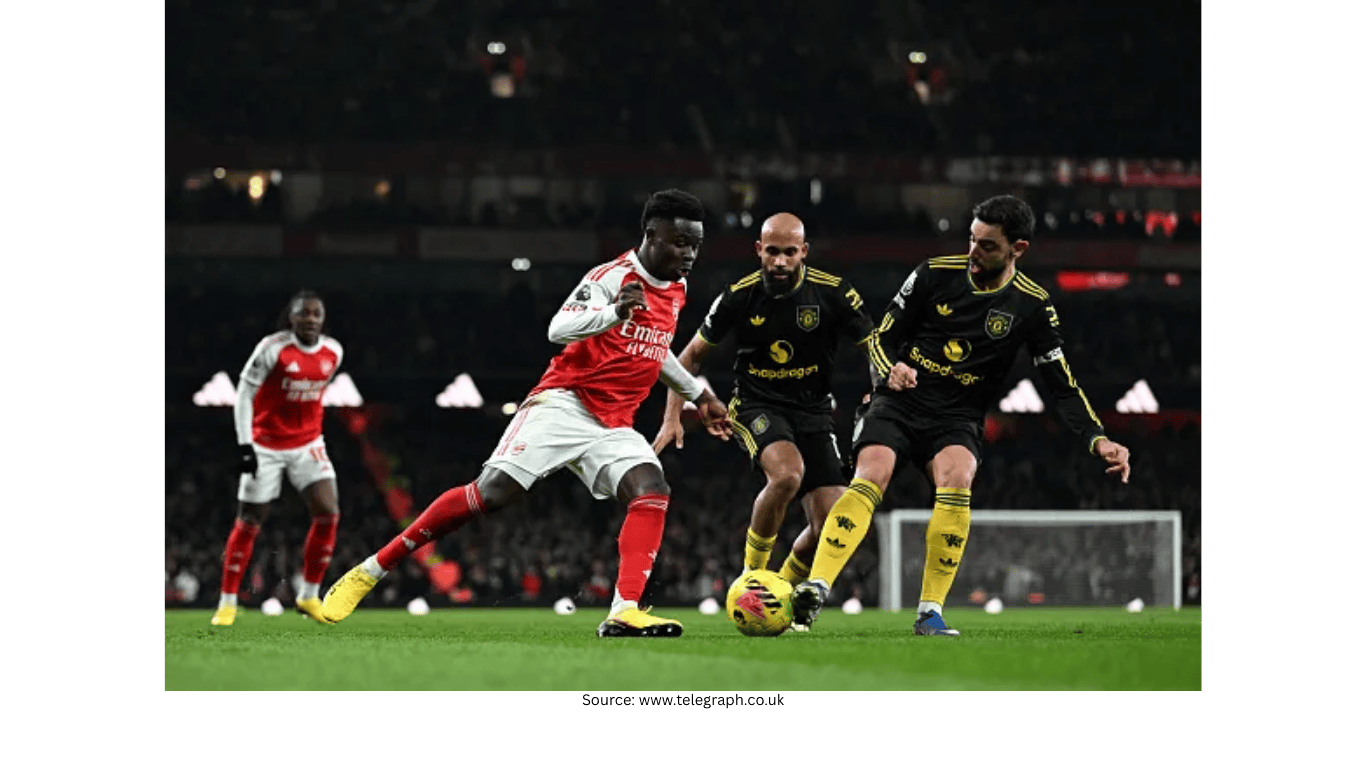
Arsenal’s cushion reduced after dramatic defeat
Arsenal remain top of the Premier League, but their margin for error has narrowed sharply. A three-game winless run has reduced their lead from seven points to four, and the latest setback came in a 3-2 home defeat to Manchester United at the Emirates Stadium. In the aftermath, former Arsenal captain Patrick Vieira questioned whether the team has the “mental strength” required to sustain a title challenge.
The match itself delivered a late twist. Matheus Cunha scored an 87th-minute winner to secure victory for Michael Carrick’s United, leaving the home side stunned. For Arsenal, the result was not only a defeat but another blow to momentum at a stage of the season when leaders often look to reinforce authority rather than invite doubt.
While Arsenal still hold a four-point advantage, the mood around the title race has shifted. The discussion has moved beyond the league table and toward performance levels, decision-making under pressure, and whether the team can respond quickly enough to prevent a wobble from becoming a defining trend.
Vieira: “Questions about the mental strength of the team”
Vieira, speaking after the game, focused on the manner of Arsenal’s defeat rather than the fact they lost. His assessment was pointed: “They are still four points clear, but there are still questions about the mental strength of the team.”
In Vieira’s view, Arsenal did not play with the freedom and intensity that has underpinned much of their best football. He singled out key attacking players, saying Bukayo Saka and Leandro Trossard “didn't produce enough to worry United.” That critique was less about individual blame and more about the collective drop-off in threat and conviction that can appear when a team is tense.
Vieira also argued Arsenal lacked a figure to change the emotional temperature of the game. “They need a leader to lift the spirit of the team,” he said, adding that the players must understand that when they are on the pitch, they need “more energy and more risks.”
His emphasis on risk was notable. In tight matches, especially those with title implications, the temptation can be to play within oneself—protecting against mistakes rather than pushing to impose. Vieira suggested Arsenal did not strike the right balance, and that the result reflected a team that was not playing with the same expressive confidence that has often defined their season.
Call for a reset: “Back to the basics”
Vieira’s prescription was direct. He said Arsenal need to “go back to the basics,” and described what that looks like in practical terms: “To express themselves, play with freedom, and go forward.”
He also broadened the critique beyond a couple of attackers, stating there were “too many players that didn't perform today.” That assessment aligns with the idea that Arsenal’s issues in this run are not isolated to one position or one moment, but instead reflect a wider drop in clarity and execution.
Vieira framed the match as an opportunity missed in terms of messaging. “It was a must-win game,” he said, adding that Arsenal “needed to send a message to the rest of the teams in the league.” The implication was that, at home and with the title race tightening, Arsenal had a chance to demonstrate authority—and instead left room for rivals to sense vulnerability.
Arteta responds: accepting opinions, focusing on performance
Arsenal manager Mikel Arteta was asked about Vieira’s comments and did not dismiss them. He said: “That's fine, we accept every opinion, where it comes and where it's coming from and they will have the right reasons to say it.”
Arteta acknowledged that mental strength will be required if Arsenal are to meet their objectives. “At the end we have to show the mental strength that we have on the pitch when it comes to a match day,” he said.
However, Arteta’s analysis leaned toward technical execution rather than purely psychological factors. He contrasted Arsenal’s level in different matches, noting they were “absolutely brilliant in Milan” but “today we weren't that good.” He added: “I don't know if it was mental because of how much they played, but because we were poor, especially technically in certain aspects of the game against a team that, when you make those mistakes, they can punish you big time and that was the difference.”
That distinction matters. Arteta did not deny the relevance of mentality, but he suggested the decisive factor was the quality of Arsenal’s play—particularly technical errors—against an opponent capable of punishing them. In other words, the manager framed the match as one where mistakes were costly, and where Arsenal’s standards dipped at the wrong time.
Roy Keane: Arsenal looked fearful under pressure
Roy Keane’s assessment was even more blunt. He accused Arsenal of being fearful and urged them to embrace the pressure that comes with leading a title race.
Keane argued that the context of the day increased the burden on Arsenal. “Pressure was on Arsenal today. They saw the other results; they have everything going for them in all competitions. That is pressure; they are feeling the pressure,” he said.
For Keane, the key issue was how Arsenal responded to that pressure. “It is how they deal with it. That's what has cost them over the last few years when they have got themselves in good positions,” he added, suggesting that this is not an entirely new test for the group.
He also pointed to a pattern across recent matches, referencing the Liverpool game, the Forest game and the defeat to United as signs of a team “losing that momentum.” Momentum, in title races, can be as valuable as points: it shapes belief internally and changes how opponents approach a match. Keane’s concern was that Arsenal’s body language and decision-making were reflecting anxiety rather than authority.
“I can't believe they don't look like a confident team,” he said. “Play the game, they are obviously playing the occasion.” His conclusion was a challenge: Arsenal must “get back to basics and embrace this challenge instead of being frightened of it.”
Gary Neville: rivals will sense opportunity
Gary Neville, speaking on his podcast, focused on what Arsenal’s recent form might signal to their closest challengers. He suggested Manchester City and Pep Guardiola would be ready to “prey on Arsenal's stuttering form.”
When asked whether City would be excited about being four points back, Neville replied: “Just a bit.” His point was not simply about the gap, but about the psychological shift that can occur when a leader shows vulnerability.
Neville also reflected on the managerial challenge of resetting a squad after a damaging result. “If you are Mikel Arteta, I was wondering what you do in the morning to reset,” he said, before describing how a manager like Guardiola might frame the opportunity to his own players.
He imagined Guardiola’s message as direct and demanding: “Are you really going to let these off the hook? They were nervous, they were anxious.” Neville suggested Guardiola would push his players with a simple question: “Do you want this? Because it's there if you want it because they are struggling.”
From Neville’s perspective, the dynamic of a chase can change quickly when the team in front begins to look uncertain. “You would prey on it a bit,” he said, acknowledging the professional reality that rivals will look for signs of weakness, regardless of relationships or shared history between coaches.
He described how City might approach the coming months: “Four points. Let's get them into March and April, let's get on their shoulder, let's see what they are about.” The phrase “on their shoulder” captured the idea of sustained pressure—staying close enough that every Arsenal slip becomes magnified, every match becomes a test, and the emotional weight increases.
What the debate reveals about Arsenal’s current moment
Across the reactions from Vieira, Arteta, Keane and Neville, a common theme emerges: Arsenal’s position at the top is real, but so is the scrutiny that comes with it. The team is still leading, yet the conversation has shifted from “how far ahead are they?” to “how will they respond?”
Vieira’s comments focused on leadership, energy and risk-taking—qualities often associated with a team that believes in itself. Keane’s critique centred on fear and the tendency to “play the occasion,” while Neville looked outward to the threat posed by rivals who will interpret Arsenal’s run as an opening. Arteta, meanwhile, acknowledged the mental side but pointed to technical shortcomings and costly mistakes as the decisive factor against a team ready to punish errors.
These perspectives are not mutually exclusive. A team can be technically below its best because it is mentally tense; it can also become mentally tense because it is making technical mistakes. In high-stakes matches, those feedback loops can become decisive.
Key points raised after the Manchester United defeat
Arsenal’s Premier League lead has been reduced from seven points to four after a three-game winless run.
Manchester United won 3-2 at the Emirates, with Matheus Cunha scoring an 87th-minute winner.
Patrick Vieira said there are “questions about the mental strength” of the Arsenal team and argued they need leadership, energy and more risk-taking.
Vieira felt Saka and Trossard did not do enough to trouble United and that too many players underperformed.
Mikel Arteta accepted outside opinions and said Arsenal must show mental strength, while also highlighting technical mistakes as the key difference.
Roy Keane said Arsenal looked fearful and must embrace the pressure rather than “playing the occasion.”
Gary Neville suggested Manchester City will see Arsenal’s form as an opportunity and will aim to apply pressure through the decisive months.
The next test is the response
Arsenal’s title challenge is not defined by a single defeat, but the reaction to a difficult spell can shape the rest of the season. Vieira’s critique, Arteta’s analysis, and the warnings from Keane and Neville all point to the same immediate requirement: Arsenal must rediscover the level, freedom and assertiveness that built their lead in the first place.
With the advantage now four points rather than seven, the margin is smaller and the spotlight brighter. Whether the issue is mentality, technique, or a combination of both, the next performances will determine whether this period is remembered as a brief wobble—or as the moment the race truly turned into a contest.