
Enzo Fernandez sets the tone as Chelsea respond at Wembley and book FA Cup final date
Football rarely allows teams the luxury of time. Form can collapse in a single evening and, just as quickly, a season can be steadied by one performance that restores belief. For Chelsea, the space between a chastening defeat at Brighton and a Wembley semi-final against Leeds was only five days, but the contrast was stark enough to feel like a full reset.
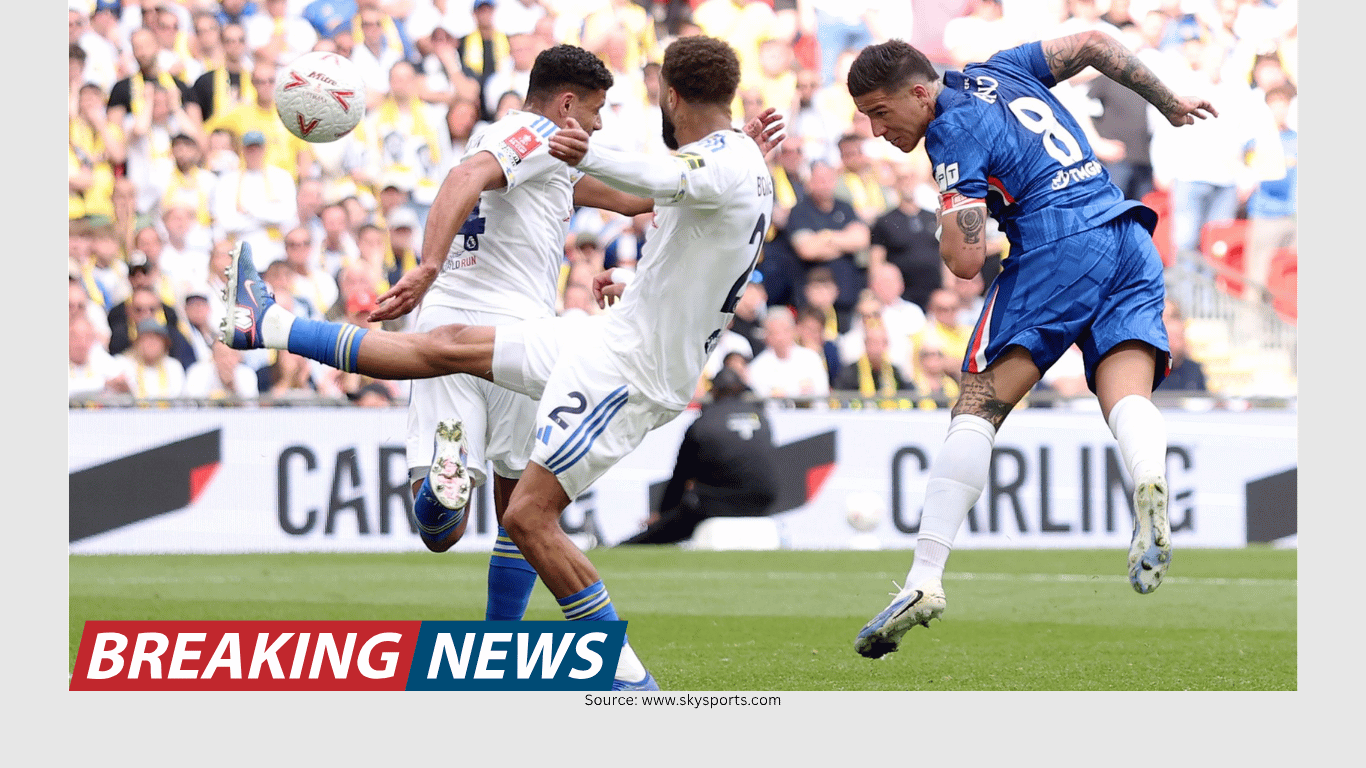
Chelsea’s reward for their response is significant: a place in the FA Cup final against Manchester City on May 16. The decisive moment came from Enzo Fernandez, whose header proved enough to beat Leeds and keep Chelsea’s season alive at a point when it had looked in danger of drifting away.
From Brighton frustration to Wembley focus
The Brighton match had been a low point. Chelsea’s display was described as “limp,” and it became the final act for Liam Rosenior. In the minutes after the final whistle, one image lingered: Fernandez, standing in front of the away end, staring into the distance. He was the last Chelsea player to leave the pitch at the Amex, even after Brighton’s players had completed their celebrations.
At the time, it looked like a wordless statement, an expression of frustration and a hint that something had to change. It was also a reminder that individuals are not separate from the collective. Fernandez, by the account of the match, was “certainly part of the problem” at Brighton, where the game passed him by as Brighton controlled the contest across the pitch.
That context made what followed at Wembley more compelling. With a place in the FA Cup final on the line, Fernandez did not fade into the background. Instead, he seized the game, delivering what was described as a “barnstorming midfield performance,” capped by the winning goal. Chelsea, too, looked like a different team: more committed, more disciplined, and far more difficult to play against.
Fernandez leads by example
Midfielders can influence matches in subtle ways—through positioning, tempo, and decision-making—but Wembley offered a more obvious demonstration of leadership. Fernandez’s performance was framed as one of taking the situation “by the scruff of the neck,” setting the tone for a display built on defensive discipline and determination.
The goal itself mattered, of course, but the wider impression was just as important. Chelsea’s showing was described as “dogged,” and Fernandez was central to that identity: driving the group on, making tackles, and competing for loose balls. In a season where momentum has often been elusive, those qualities were presented as the difference between repeating recent mistakes and producing a result under pressure.
It is also worth noting that this was not Fernandez’s first decisive contribution in a major moment under the current interim leadership. Earlier in the season, he scored a 94th-minute equaliser against Manchester City in January—an important detail because it came in Calum McFarlane’s first game as interim boss.
A different Chelsea: intensity, discipline, and a fast start
The narrative of Chelsea’s recent run has been one of struggle, particularly in front of goal. They had failed to score during a five-game losing streak in the Premier League, a sequence that ultimately cost Rosenior his job. Against Leeds at Wembley, it took them only 23 minutes to find the net.
That early breakthrough did more than put Chelsea ahead. It changed the emotional shape of the match and, potentially, the feeling within the squad. McFarlane later emphasised how important it was to “break the momentum and the form” Chelsea had been carrying. The implication was clear: confidence is fragile, and a goal at a big moment can quickly change the mood.
The contrast with Brighton was highlighted in physical terms too. Chelsea “left everything out there at Wembley,” a pointed comparison to the claim that they “didn’t make a tackle for the first 30 minutes” at Brighton. Whether taken literally or as a reflection of intensity, the message was unmistakable: Wembley demanded effort and organisation, and Chelsea delivered both.
McFarlane’s calm approach in a crisis
Interim appointments can bring uncertainty, but they can also simplify a team’s mindset. McFarlane, tasked with stepping into a crisis, was asked directly about the biggest difference between the Wembley performance and the 3-0 defeat on the south coast. His answer was notable not for what it revealed, but for what it avoided.
“We haven’t even looked at the Brighton performance, we’ve been focused on Leeds,” he said, sidestepping the comparison “like a manager with 1,000 games under his belt.” The line suggested a deliberate attempt to keep attention on the next task rather than the last disappointment—an approach that can be especially useful when a group is short on confidence.
Yet McFarlane was far more expansive when discussing Fernandez, whose ability to arrive in scoring positions has clearly impressed the coaching staff. In a light-hearted exchange, McFarlane recalled a comment to his midfielder: “I said to him, ‘you like scoring at the back post for me’ and he just laughed.”
Behind the humour was a clear footballing point. McFarlane praised Fernandez’s timing when Chelsea attack down the right, highlighting his “ability to actually get good distance and height on his jump” and the quality of his heading technique. These are specific attributes, and they speak to a player whose impact is not limited to passing and midfield control.
Why Fernandez’s goal threat matters
For any side, goals from midfield can be a crucial supplement, particularly when forwards are struggling or when a team needs multiple sources of threat. Chelsea’s recent scoring issues made Fernandez’s contribution even more valuable. His header against Leeds was not just a match-winner; it was a sign that Chelsea can find solutions from different areas of the pitch.
McFarlane’s assessment of Fernandez went beyond the goal, describing him as a player with “so much talent” and “so much fight.” The combination of technical quality and competitiveness was presented as vital for the group, especially in difficult moments. “He’s massive for this group,” McFarlane said, before adding a broader point about versatility: “the best thing about Enzo is that he can do a bit of everything.”
That versatility—attacking movement, aerial ability, ball-winning, and leadership—helps explain why Fernandez’s performance was framed as transformative. When a team is under pressure, a midfielder who can influence multiple phases of play can stabilise the entire structure.
Man of the match and a statement performance
McFarlane concluded that Fernandez “was exceptional today and deserved his man of the match.” Individual awards are secondary to results, but in this context the recognition served as a marker of how the match was perceived: not merely as a narrow win, but as a performance with a clear standard-setter.
The broader team display was also described in emphatic terms—“chalk and cheese” compared with Brighton—suggesting that Chelsea’s players responded to criticism with a level of commitment that had been missing. For supporters, this kind of reaction can be as important as the trophy chase itself, because it signals that the squad still has resilience and pride.
What the win changes for Chelsea’s run-in
Chelsea now have “the opportunity to beat Pep Guardiola in a major final on May 16.” That is the challenge ahead, but the Leeds win also shapes the immediate future. McFarlane spoke about confidence going into “the next five games,” indicating that the semi-final was viewed as a turning point rather than an isolated cup result.
He acknowledged the season has not unfolded as hoped—“It’s unfortunately not worked out like that this year”—but set out the aim for the closing stretch: “we want to win every single game from now to the end of the season.”
Importantly, he framed motivation in collective terms, stressing it was not about searching for “extra motivation” but about basic standards and responsibility: “We want to do it for ourselves, we want to do it for the fans and the club, everyone.”
Key takeaways from Chelsea’s Wembley response
A rapid shift in mood: The space between Brighton and Wembley was only five days, but Chelsea’s performance level and intensity changed dramatically.
Fernandez as the difference-maker: After being part of the problem at Brighton, he led the solution at Wembley with a dominant midfield display and the winning header.
Defensive discipline returned: Chelsea were described as “dogged” and “defensively-disciplined,” a sharp contrast to the earlier defeat.
McFarlane’s message stayed simple: Rather than dwelling on Brighton, the interim coach kept the focus on Leeds and praised specific qualities that helped deliver the result.
Confidence ahead of the run-in: Breaking a poor sequence—especially scoring after a goal drought—was presented as crucial for belief in the final weeks.
A season still alive, and a final now in view
Wembley wins can sometimes flatter teams, masking deeper issues with a single big occasion. But Chelsea’s victory over Leeds was presented less as a fortunate escape and more as a demonstration of spirit and determination at a critical moment. The semi-final demanded a response after Brighton, and the players provided it.
For Fernandez, the shift was personal as well as collective: from a midfielder overrun on the south coast to a match-winner on the national stage. For McFarlane, it was another instance of his team delivering in a high-pressure situation, setting up a major final against Manchester City on May 16.
Chelsea’s season has been turbulent, and the challenges are not over. But with a place in the FA Cup final secured and confidence boosted by a disciplined performance, the immediate storyline is clear: five days after staring into the abyss, Chelsea have given themselves something substantial to fight for.