
Carragher’s tactical takeaway: How Manchester City’s midfield turned the tide against Arsenal
A title race tightened by one match — and one midfield story
Manchester City’s 2-1 victory over Arsenal at the Etihad Stadium did more than deliver three points. It reshaped the look and feel of the Premier League run-in. The result moved Pep Guardiola’s side to within three points of Mikel Arteta’s league leaders, with City also holding a game in hand. In other words, the margins at the top narrowed sharply, and the stakes for every tactical detail grew even larger.
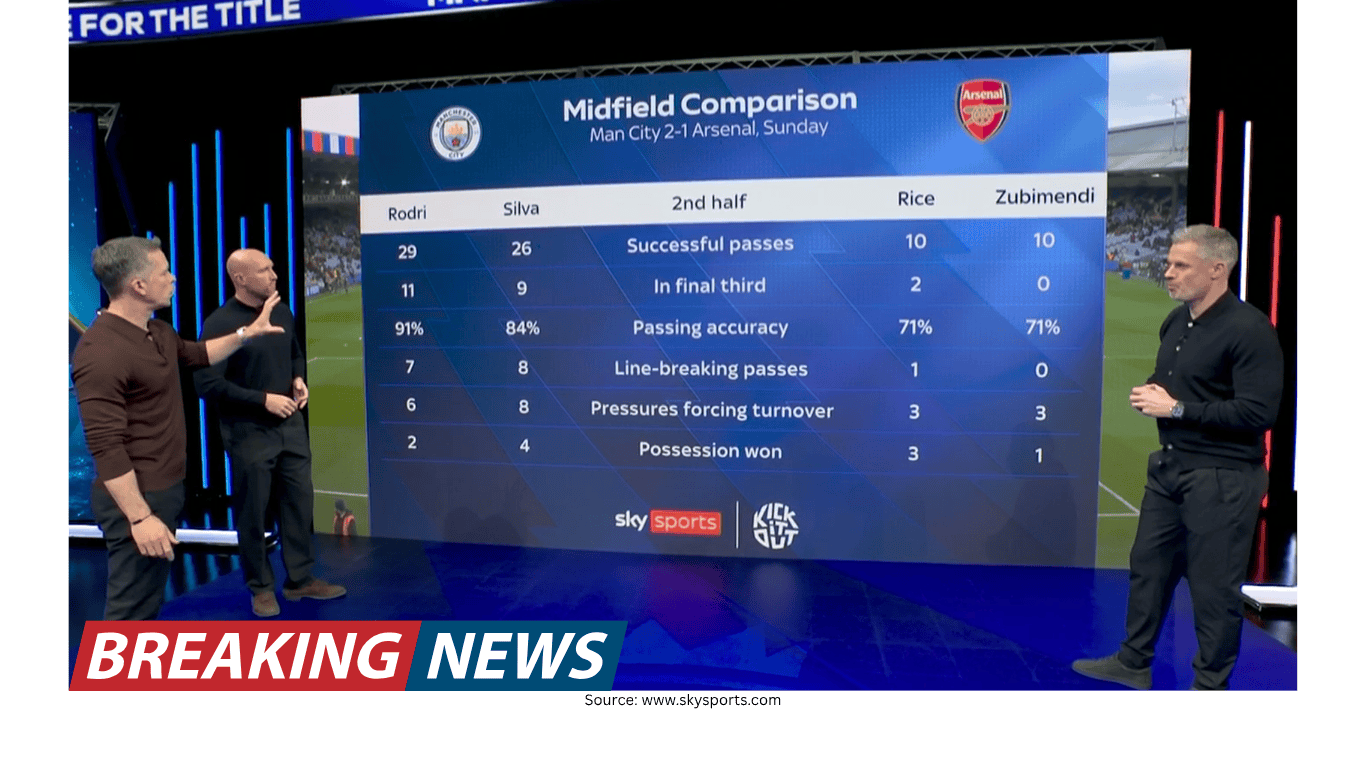
When Jamie Carragher reviewed the game, he returned repeatedly to a single idea: the contest was decided in midfield. In his view, Manchester City’s experienced duo Rodri and Bernardo Silva did not merely play well; they found solutions under pressure, altered their positioning to change the geometry of the match, and showed a level of composure that Arsenal could not match when the game demanded calm decision-making on the ball.
“The game was won in midfield”
Carragher’s headline assessment was unequivocal. He praised Rodri and Bernardo Silva as a pairing, describing their display in extraordinary terms and arguing that their control and ingenuity tilted the entire match. The key point was not simply that they completed passes or covered ground; it was that they repeatedly made themselves available in the most uncomfortable zones of the pitch, even when Arsenal’s press initially appeared to be working.
In Carragher’s framing, Arsenal’s midfield pressure early on was both aggressive and productive. Within the opening 15 minutes, Arsenal won possession in the final third six times — a figure Carragher highlighted as the most achieved by any side in the Premier League this season. That early spell suggested Arsenal could disrupt City’s rhythm and force mistakes in dangerous areas.
But Carragher argued that the early success of Arsenal’s press created a problem that City’s midfielders were capable of solving. The match became a test of who could adapt first: the pressers trying to lock the game in Arsenal’s preferred territory, or the ball-players trying to escape, reset, and build attacks with control.
Arsenal’s early press: intensity, territory, and a clear plan
The opening pattern, as Carragher described it, saw Arsenal’s midfielders stepping in aggressively. With Declan Rice and Martin Odegaard pushing up to engage, City initially struggled to feed the ball cleanly into their usual advanced areas. Carragher’s point was that the first wave of pressure was not random; it was targeted at cutting off the short connections that allow City to progress through the middle.
In that phase, Arsenal’s ability to win the ball high up the pitch created the impression that City might be forced into longer, riskier passes or hurried decisions. Pressing success is often measured not only in turnovers but in what it prevents: calm build-up, controlled possession, and the ability to choose when to accelerate. For a brief period, Arsenal were achieving that.
However, Carragher’s analysis suggested that Arsenal’s press, while effective, also set the stage for a counter-adjustment. Once City’s midfielders decided to drop deeper and take responsibility for first-phase build-up, the pressing picture changed.
Rodri and Bernardo Silva’s response: dropping deeper to change the game
Carragher highlighted a crucial tactical shift: Rodri and Bernardo Silva began to drop into deeper areas to receive the ball, at times effectively joining the defensive line. In his description, they ended up “in the back four,” behaving like centre-backs in possession to ensure City could keep playing through Arsenal’s pressure.
This was not merely a positional tweak. It was a statement of intent and a test of nerve. By dropping so deep, City’s midfielders invited Arsenal to commit further forward, but they also gave City extra angles and extra security in the first pass. If Arsenal’s press was designed to stop City playing into midfield, City’s midfielders responded by becoming the starting point of the build-up themselves.
Carragher emphasised that this approach required bravery. Early on, there were moments when City lost the ball in those deep areas — he pointed specifically to an instance involving Bernardo Silva against Declan Rice. Yet, in Carragher’s view, the defining quality was that the mistake did not change City’s behaviour. The midfielders kept showing for the ball, kept demanding it again, and kept trusting their ability to play out.
That willingness to continue taking the ball under pressure, especially in a game of such magnitude, was presented as a decisive difference between the teams.
Courage in possession: the willingness to receive the ball in the most dangerous zones
Carragher’s most striking theme was “courage on the ball.” He argued that it is easy to look brave when pressing without possession, because the risk is shared and the consequences of a single action are less direct. The more difficult courage, he suggested, is the courage to receive the ball near your own goal, with opponents closing in, knowing that a mistake can immediately become a chance conceded.
In his analysis, Rodri and Bernardo Silva showed that courage repeatedly. Carragher pointed to situations where they were prepared to take the ball from the goalkeeper in the six-yard box and dribble or pass their way out. For him, that was not showmanship; it was a practical solution to a pressing problem, and it was also a psychological edge. When midfielders take the ball in those areas, they signal to teammates that the team will not panic and will not abandon its approach at the first sign of pressure.
He contrasted this with Arsenal’s difficulty in playing out from the back. Even when the numbers suggested Arsenal should be able to build — Carragher referenced a “7 vs 4” scenario including the goalkeeper — Arsenal were, in his view, less willing to take those risks. The implication was not that Arsenal lacked talent, but that in this match, at these moments, they did not show the same appetite to receive and play through pressure.
Arsenal’s build-up choices: going long to bypass City’s press
Another part of Carragher’s breakdown focused on Arsenal’s response to City’s pressing structure. He noted that Arsenal had faced City’s four-man press before and that, in this game, Arsenal opted to go long from goal kicks rather than repeatedly attempting to play through the first line.
Carragher described a setup designed to bypass City’s front four. In his account, Arsenal adjusted their positions from goal kicks, with defenders and midfielders arranged to support a longer distribution plan. The midfield line, he noted, was higher than in a previous meeting because the intention was to move the ball over the press rather than through it.
He also pushed back on the idea that Arsenal were “adventurous” in possession, suggesting instead that much of their adventure came without the ball — in their pressing and defensive work — rather than in their willingness to build under pressure. In Carragher’s framing, Arsenal’s more direct approach was a sign of discomfort, a pragmatic choice that reduced risk but also limited their control of the match.
Why City’s adjustment mattered: turning Arsenal’s strength into a new problem
Carragher’s analysis presented City’s deep-dropping midfielders as a way of flipping the script. Arsenal’s early pressing success created a clear pattern: close down City’s midfield access, win the ball high, and attack quickly. But once Rodri and Bernardo Silva began receiving deeper, City had effectively changed where the pressure battle took place.
Instead of trying to force passes into crowded midfield zones, City created a new build-up platform. With Rodri and Silva acting as additional outlets alongside the defenders, City could draw Arsenal forward and then play through the press with short combinations. Carragher’s phrase captured the essence of it: City saw a problem and “gave Arsenal a problem.”
The key was persistence. The plan only works if the players involved keep asking for the ball, even after an early turnover. Carragher’s praise was rooted in that repeated willingness to take responsibility.
Moments that shaped the game: Carragher’s focus on Martin Zubimendi
Alongside his praise for City’s midfield, Carragher also highlighted moments involving Arsenal midfielder Martin Zubimendi. His analysis connected Zubimendi to two pivotal sequences: one around the opening goal and another in the build-up to City’s second.
On the first, Carragher discussed Zubimendi’s role in the phase of play around a “wonderful solo goal” scored by Cherki that opened the scoring for City. Carragher noted that, in one moment, Zubimendi helped his defence by moving across and crowding out Cherki, effectively shadowing him and filling spaces to limit the danger. But seconds later, in a near-identical situation as the ball moved quickly, Zubimendi could not get across in time to apply the same pressure.
Carragher’s point was not that the defensive task was easy. He acknowledged that even four players around an attacker is a difficult proposition for any player. But he argued that the slight difference — one fewer defender in the immediate area and a fraction more space — was enough for a top attacker to exploit. In fine margins, the speed of the shift and the ability to cover both sides mattered.
The second goal sequence: possession risk and the consequences of a turnover
Carragher also pointed to Zubimendi giving away possession in the build-up to City’s second goal. In his description, a forward ball from Zubimendi went through to goalkeeper Gianluigi Donnarumma, allowing the goalkeeper to initiate a City attack.
He framed this moment as the “flip side” of the courage he had praised in Rodri and Bernardo Silva. Where City’s midfielders kept taking the ball in difficult areas and playing through pressure, Carragher suggested that Arsenal’s midfield did not meet the same standard in that specific moment. He underscored the expectation on a player like Zubimendi, describing him as a European champion with Spain and implying that such players are selected specifically to handle high-pressure situations in tough arenas.
In Carragher’s view, these moments are not just isolated errors; they are the kinds of decisions and executions that determine matches between top sides.
Covering ground and covering space: the right side issue
In the same broader discussion, Carragher highlighted a later issue: Zubimendi being unable to cover the right side of the pitch as Gabriel Martinelli jumped to press Marc Guehi, while Donnarumma played the ball over the winger to Nico O’Reilly.
Carragher linked this to Declan Rice’s preferences in midfield positioning, noting that Rice likes operating on the left of central midfield and that he urged Zubimendi to shift across. Carragher’s assessment was that Zubimendi could not get across quickly enough and “hasn’t got the legs to” in that moment. The emphasis again was on fine margins: when one player steps out to press, the covering movements behind must be immediate and decisive.
What the match suggested about control, not just effort
Carragher’s overall argument was not that Arsenal lacked effort. In fact, he highlighted their early pressing numbers as evidence of intensity and organisation. His critique was more specific: in this match, Arsenal did not show the same level of composure and bravery in possession as Manchester City did, particularly in the most pressurised build-up moments.
For City, Rodri and Bernardo Silva symbolised a team comfortable with risk when it is calculated and supported by structure. Their willingness to receive deep, to keep receiving after a mistake, and to play through pressure rather than around it, was presented as the foundation for City’s control. For Arsenal, the choice to go long more often and the difficulty in playing out, even with numerical advantages, was presented as a sign that City had won the psychological and tactical battle in the middle.
Key themes from Carragher’s analysis
Midfield decided the match: Carragher argued that City’s victory was built on Rodri and Bernardo Silva controlling and solving the central battle.
Arsenal’s press started strongly: Six high turnovers in the opening 15 minutes underlined how effective Arsenal were early on.
City adapted by dropping deeper: Rodri and Silva moved into deeper build-up positions, at times resembling additional defenders, to play through pressure.
Bravery in possession was decisive: Carragher repeatedly stressed the courage required to take the ball near your own goal in a high-stakes match.
Arsenal’s build-up was more cautious: Going long from goal kicks was framed as bypassing City’s press rather than confronting it.
Fine margins in key sequences: Carragher highlighted moments involving Zubimendi around the opening goal, a turnover before City’s second, and difficulty covering across midfield.
The bigger picture: a finale shaped by small decisions
With City now three points behind Arsenal and holding a game in hand, the league’s closing stretch looks set to be defined by details. Carragher’s analysis of this match offered a reminder of how those details can be less about spectacular moments and more about repeatable behaviours: who shows for the ball, who keeps showing after an error, and who can turn an opponent’s best weapon into a problem to solve.
In Carragher’s telling, Manchester City’s midfielders did exactly that. Arsenal pressed, City adjusted, and the match became a demonstration of how composure and courage in possession can be as decisive as intensity without it.