
Real Madrid Celebrate a Bernabéu Revival with Big Win Over Real Sociedad
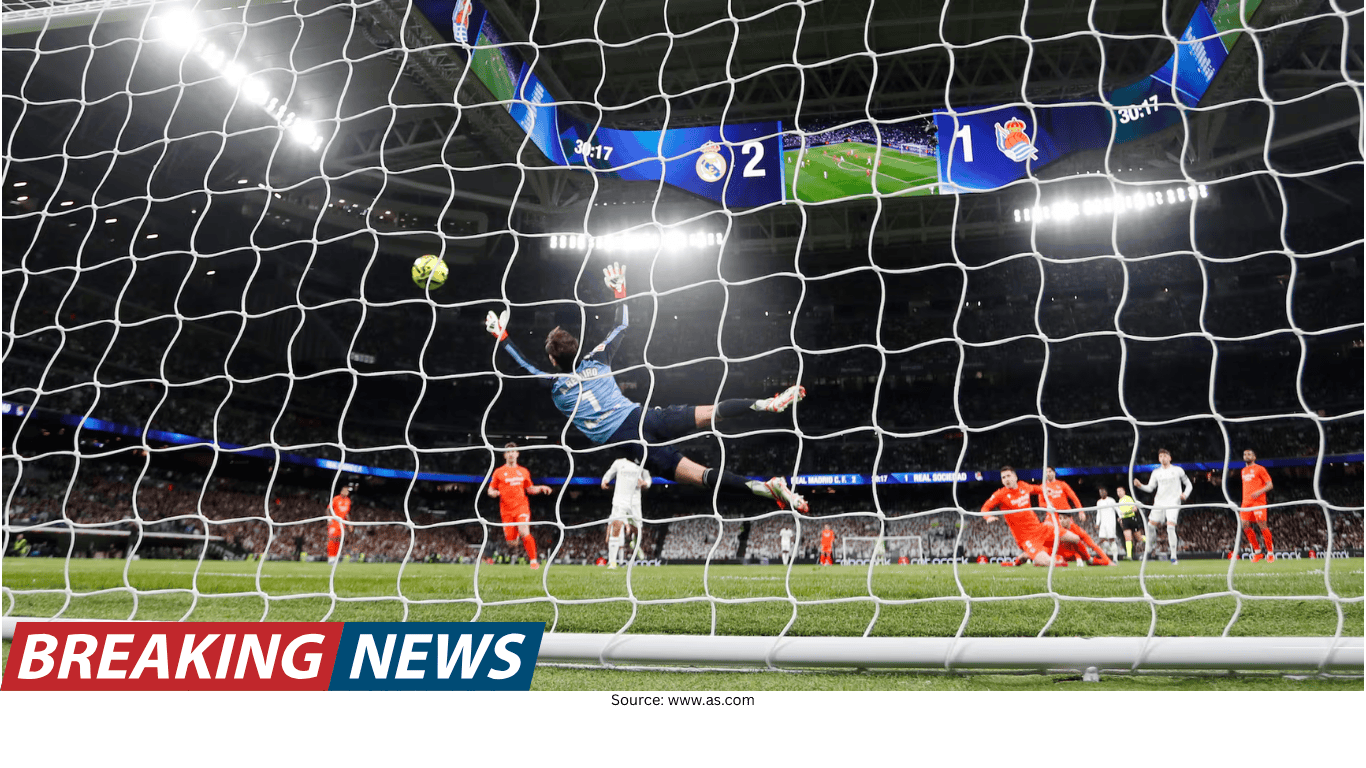
A home night that felt like a turning point
Real Madrid’s relationship with the Bernabéu can be intense and, at times, unstable, but this match ended with the sense of a renewed understanding between team and crowd. On a night framed as a “happy Valentine’s Day” for the home side, Madrid produced a commanding win over Real Sociedad, a result that carried both immediate and symbolic weight. It sent them to the top of the table for at least 48 hours, extended their league streak to eight consecutive victories, and offered a set of encouraging signs at a moment when the calendar is demanding and the stakes are rising.
The scoreline was emphatic, yet the performance was not presented as a flawless exhibition of control. Instead, it was a reminder that football does not always follow a straight path: sometimes results arrive first, and the more complete version of the team follows later. Madrid, in this telling, are travelling one of those alternative routes—winning while still searching for their best football. Against Sociedad, they were sharper in finishing than in creation, but that sharpness was decisive.
Contrasting contexts: rotation, fatigue and a looming trip
The match also arrived at an awkward time for both sides, though in different ways. Real Sociedad came to Madrid after a crucial Copa del Rey match at San Mamés, and the physical and mental cost was evident. Their coach, Matarazzo, made four changes at the Bernabéu—rotation that was described as moderate and not a full reshuffle of the core of the team, but still a reflection of fatigue management.
For Madrid, the game sat on the road toward Lisbon and a return to a stadium that had recently been painful territory. The trip to Da Luz was framed as a kind of penitence for a bad night there little more than two weeks earlier, and this time, it would be “without a safety net.” With that in mind, Arbeloa chose to rest Kylian Mbappé, the team’s 38-goal figurehead, because of his importance for the upcoming task. It was a decision that came with risk: the record offered a warning that in the four league matches in which Mbappé had failed to score, Madrid had only won one.
Yet the evening quickly became an argument that Madrid can still function without him—at least on certain nights, and with the right supporting cast stepping forward.
Gonzalo strikes early and underlines his value
The first major storyline belonged to Gonzalo, whose scoring record without Mbappé was already notable. He had scored ten goals in matches the Frenchman did not play, and he made it eleven almost immediately here. Madrid went ahead in the fourth minute, and the goal was described as a classic centre-forward’s finish: a smart run, a controlled strike taken in motion, and a subtle touch—“with the toe”—that opened the angle just enough for the ball to almost stroll into the net.
Trent Alexander-Arnold provided the pass, and the assist highlighted what Madrid see as his defining quality: elite distribution. The move also hinted at a tactical idea. With Sociedad inclined to defend aggressively and step forward, they were exposed when forced to turn and retreat. Madrid leaned into long balls into space, and with Eduardo Camavinga acting as a launching point, the home side looked to exploit the gaps behind the visitors’ line.
Gonzalo nearly had another when he hesitated in the area, switching feet at the wrong moment. The message was blunt: in the penalty box, extra steps can be costly.
A match of penalties and defensive mistakes
For all Madrid’s early advantage, the game did not settle into a calm pattern. The lead was soon threatened by what was described as the youthful inexperience of Dean Huijsen. Yangel Herrera surged into Madrid’s box “like a knife,” and the defender brought him down when the safer choice would have been to block the shot rather than make contact. The episode drew a mixed reaction from the stands, a crowd portrayed as capable of whistling and applauding within the same minute—confused, frustrated, then quick to reconsider.
From one error, the match swung to another. Sociedad’s Aramburu became the next defender caught in a decisive moment, beaten by a Vinícius Júnior feint and then leaving a foot in at the wrong time in the area. Vinícius, the report noted, did plenty to make the contact visible, and the penalty was considered more debatable than the earlier one at the other end. Still, the decision stood, and Vinícius converted to restore Madrid’s lead.
That sequence captured Vinícius in two roles at once: both the cause of the incident and the player who delivered the consequence. Over long stretches of the match he offered reminders of the player he once was at his most dazzling, and the suggestion was that he is moving back toward that level—perhaps even with the threat of staying there. Aramburu, repeatedly “tortured” by the winger’s directness, served as the clearest evidence.
Goals arrive faster than control
The rhythm of the game was described as uneven. There was no clear, sustained dominator. Sociedad had more of the ball “on points,” while Madrid edged the contest in chances by a similar margin. Yet goals kept arriving in a night where both defences were portrayed as transparent.
Madrid’s third goal came when Sociedad allowed Federico Valverde to receive the ball at the edge of the area and shoot without meaningful pressure. He took full advantage, finding the top corner and pushing the scoreline further in Madrid’s favour. By half-time, Arbeloa’s side had scored three, and Gonzalo even had a fourth chance that went wide.
There was an acknowledgement that the football itself did not fully justify the scale of the lead, but also an acceptance of a simple truth: few complain when the scoreboard looks that good. Madrid’s “reasons” were the goals, and that was enough.
Vinícius seals it early in the second half
Any remaining tension was removed quickly after the break. Vinícius ended the contest as a spectacle with another decisive action down by the byline, producing what was called a brilliant piece of skill. Aramburu, having lost track of him again, brought him down once more. It was the second penalty conceded by the full-back and the second successfully dispatched by Vinícius, who completed his brace from the spot.
At 4–1, the match lost its competitive edge, but it did not become quiet. Chances continued to appear in both boxes, attributed largely to a general relaxation now that the outcome felt secure.
Chances keep coming as the match opens up
Even with the points effectively settled, opportunities arrived “in bulk.” Gonzalo had two more openings, while Valverde remained involved. Sociedad also had moments through Jon Martín and Aihen Muñoz, and Madrid’s attacking options continued to surface with Vinícius and Arda Güler among those mentioned as part of the late flow of chances.
The overall picture was of a match that, once broken open by goals and penalties, never returned to a tight tactical shape. Instead, it became a game of transitions, loose defending, and repeated visits to the penalty areas—entertaining in its volume of chances, if not always controlled in its structure.
Managing minutes: Carvajal and Alaba return
With the result out of danger, Arbeloa used the closing stages to manage his squad. Dani Carvajal and David Alaba came on, both treated carefully up to this point as players returning from issues. The match conditions did not allow for a definitive assessment—there was no real “trial” left to pass—but Carvajal did have a notable defensive action, intercepting a shot from Gonçalo Guedes that drew approval from a crowd already leaning toward celebration.
Those substitutions also carried a broader implication: Madrid are not simply accumulating points, they are also trying to rebuild pieces of the squad at the right time. The mention of Antonio Rüdiger “reforesting” the defence, with Benfica on the horizon, reinforced the sense that this was a night of practical progress as much as a night of goals.
Trent’s passing, Valverde’s cover, and a glimpse of a plan
Beyond the headline scorers, the match offered smaller but significant notes. Trent Alexander-Arnold’s passing was singled out as first-class, while Valverde was described as helping to cover his defensive shortcomings. That balance—extracting the best from a player’s strengths while protecting the team from his weaknesses—was presented as one of the more promising developments.
Madrid’s use of direct balls into space also suggested a willingness to adapt to opponents and circumstances, rather than insisting on a single style. Against a Sociedad side whose forward-defending approach left them vulnerable on the turn, Madrid’s long passing and quick runs were an efficient solution.
Real Sociedad fall short at both ends
From Sociedad’s perspective, the match was described as a significant comedown. The heavy defeat in Bilbao had already reduced them, and at the Bernabéu they neither defended nor attacked—two “nots” that, put together, lead inevitably to defeat. Even if they had more of the ball at times, they did not translate that into authority, and their defensive errors proved costly.
The penalty incidents, the space afforded for Valverde’s strike, and the general openness after the break all contributed to a night that did not match the pre-game expectations around the visitors.
Key match facts
- Final score: Real Madrid 4–1 Real Sociedad
- Goals: 1–0 Gonzalo (4'); 1–1 Oyarzabal (20'); 2–1 Vinícius Júnior (24', pen.); 3–1 Federico Valverde (30'); 4–1 Vinícius Júnior (47', pen.)
- Penalties: Vinícius Júnior scored two; both were conceded by Aramburu
- Referee: Francisco José Hernández Maeso; VAR: Daniel Jesús Trujillo Suárez, Javier Iglesias Villanueva
- Bookings noted: Dean Huijsen (19'); Beñat Turrientes (91')
What the win leaves behind
Madrid’s victory can be read on multiple levels without overstating any single conclusion. It was a big scoreline built on sharp finishing, penalties won through Vinícius’ constant threat, and a centre-forward’s early statement from Gonzalo. It also came with reminders of fragility—moments of defensive rashness, stretches without clear dominance, and a match that could feel chaotic in its transitions.
Still, the broader outcome mattered: another league win, another step in a strong run of results, and a brief climb to the top of the table. Perhaps most importantly for the mood around the club, it felt like a night when the Bernabéu leaned back toward the team rather than away from it. In a season where the “grey sofa” of doubt has been a recurring image, this was an evening that looked, at least for now, decidedly brighter.