
Arsenal held at Wolves as late Edozie moment punishes below-par leaders
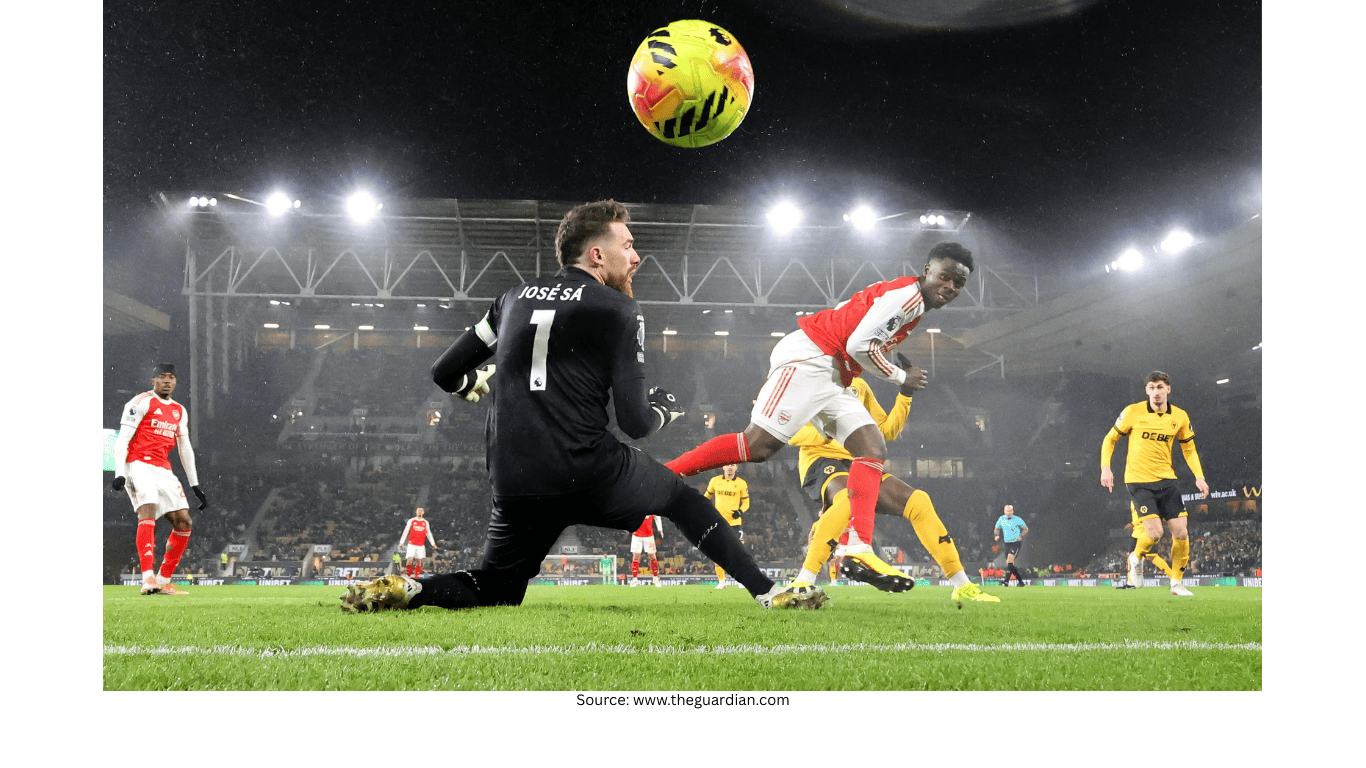
A cold night, a costly outcome for the leaders
Arsenal left Molineux with a result that felt like a warning rather than a statement. In freezing conditions, with rain swirling into sleet and snow, the Premier League leaders were pegged back to a 2-2 draw by a Wolves side described as the league’s worst team. The equaliser came late, and it came in a way that underlined Arsenal’s loss of control: Tom Edozie’s shot struck the post and went in off Riccardo Calafiori, a late substitute.
From the outside, a point away from home can be framed as acceptable. But the tone of the night suggested something else. Arsenal’s performance was portrayed as falling short of what champions typically produce, particularly after they had established a two-goal cushion. Wolves, initially passive and shotless for long stretches, found a route back into the contest and then seized it.
The draw also landed in a broader context. Arsenal were described as five points clear of Manchester City, having played a game more, and with only two wins in their past seven matches. In that light, surrendering a lead against bottom opposition did not read like a minor inconvenience; it looked like a new complication in a title race where margins can tighten quickly.
Fast start: Saka sets the early tone
The opening minutes pointed towards a routine away win. Arsenal struck early, with Bukayo Saka heading in a fifth-minute opener from a Declan Rice cross. Saka was operating in a more central role, described as a No 10, and his movement for the goal was presented as another example of his versatility.
The goal had an immediate effect on the mood inside the stadium. It silenced the home crowd and stripped away much of the early optimism of an upset. Wolves were characterised as passive, sitting in a low block and allowing Arsenal to dictate the tempo and territory.
Yet even as Arsenal controlled the ball, the match narrative suggested the performance never truly rose to match the scoreline. The conditions were harsh, but the expectation remained that a title-chasing side should still create more clarity and conviction against opponents struggling at the bottom of the table.
Control without cutting edge
Wolves’ approach in the first half was described as cautious: a low block, little aggression in the press, and long periods without threatening the Arsenal goal. Arsenal, by contrast, had time and space. That should have translated into a steady stream of clear chances, but it did not.
Noni Madueke had a moment that hinted at danger when he tested José Sá, who spilled the shot before the situation was cleared with Gabriel Martinelli nearby. But beyond isolated incidents, Sá was left relatively untroubled despite Wolves’ willingness to concede possession.
Up front, Arsenal’s £64m striker Viktor Gyökeres was described as receiving little service. The contrast between the teams on paper was emphasised: Wolves started with Adam Armstrong, a January signing from the Championship, while Arsenal fielded a high-profile centre-forward. In practice, the gap was harder to spot, not because Wolves were dominant, but because Arsenal did not translate their superiority into sustained attacking threat.
There was also a sense that Arsenal’s intensity dipped as the temperature dropped. The match was framed as the kind of difficult, uncomfortable away fixture that can test a title contender’s mentality and execution. Arsenal, in this account, failed that test.
Wolves find signs of fight as the weather turns
For much of the first half-hour, Wolves offered almost nothing in attack. They were described as failing to register a single shot in that period, a detail that aligned with the framing of the contest as the worst attack against the best defence.
But as rain became snow, the home crowd began to respond to the fact the deficit remained at one. Wolves were not creating chances, yet there was a growing appreciation for resistance and for any sign that the match might not be over.
Substitute Tolu Arokodare, introduced during the game, was noted for winning a physical battle with William Saliba. Even if it did not immediately produce a chance, it suggested Wolves were beginning to compete more forcefully in duels and second balls—areas that can shift momentum even when a team is short on quality.
Arsenal, meanwhile, were described as starting to lose duels and seeing their attacks stifled. The resurgence was said to be more evident in the stands than on the pitch at first, but it was a change in atmosphere that Arsenal did not fully extinguish.
Hincapié doubles the lead, but the warning signs remain
Arsenal eventually found their second goal, and it came through an unusual source. Piero Hincapié moved up from left-back into a more advanced position, getting between Wolves defenders to meet a precise pass from Gabriel Magalhães into the channel. He finished by slotting past Sá for what was described as his first Arsenal goal.
The goal had a layer of drama. The assistant referee belatedly raised a flag, but video assistant referee intervention overturned the offside decision and awarded the goal. For the away end, it was both a reason to celebrate and, in the context of the bitter conditions, “a second excuse to get warm.”
At 2-0, the match should have been settled. But the description of Arsenal’s night did not suggest a team in full command. Even with the lead, they were portrayed as playing below their maximum, and Wolves were still pushing to make the night awkward in any way possible.
Bueno’s stunning strike changes the mood
If Arsenal assumed the second goal would kill the contest, Hugo Bueno delivered a sharp rebuttal. Popping up on the right wing, he cut inside and curled a shot into the top corner. The finish was described as a surprise “to everyone,” and it immediately altered the emotional balance of the match.
Goals like that do more than reduce a deficit. They inject belief into the team that scores and uncertainty into the one that concedes. Wolves, previously passive, were now unsettled in a more positive sense—energised, louder, and more willing to test Arsenal’s composure.
From Arsenal’s perspective, the concession was damaging because it arrived after they had already been criticised for a lack of sharpness. A team that is not playing at full intensity can sometimes manage a game at 2-0; at 2-1, the same lack of edge can become a problem.
Late pressure, and Edozie’s decisive contribution
As Wolves pressed, Arsenal struggled to cope with the rising intensity. Mikel Arteta’s urgency was visible on the touchline, where he spent the night exposed to the elements, described as being covered in a “cocktail of rain, sleet and snow.” The importance of the result was clear in his behaviour, but the match drifted towards a scenario Arsenal were failing to control.
Wolves introduced Tom Edozie with six minutes left, for what was described as the first senior action of his career. It might have looked like a low-risk move at that stage, yet it became pivotal. Edozie’s involvement was immediate and ultimately decisive.
The equaliser was messy and cruel from an Arsenal perspective. Edozie’s shot hit the post and went in off Riccardo Calafiori, who had been introduced as a late substitute. The goal was credited as Edozie’s debut strike, and it was framed as a just punishment for Arsenal’s ineffectiveness on the night.
For Wolves, it was a moment to remember: a late comeback from two goals down, driven by a spectacular strike and capped by a debut goal. For Arsenal, it was the opposite—a match they would rather forget, yet one that could linger because of its potential implications in the title race.
Key match details
- Score: Wolves 2-2 Arsenal
- Arsenal goals: Bukayo Saka (header from Declan Rice cross), Piero Hincapié (VAR-overturned offside decision)
- Wolves goals: Hugo Bueno (curling shot into the top corner), Tom Edozie (late effort in off Riccardo Calafiori after hitting the post)
- Match themes: Arsenal’s early control, lack of clear chances despite space, Wolves’ improved aggression, late pressure and an equaliser that punished Arsenal’s drop-off
What the draw says about Arsenal’s night
Arsenal’s start offered the blueprint of a comfortable away win: early goal, territorial dominance, and an opponent content to sit deep. But the account of the match repeatedly returned to the same critique: control did not become authority, and a two-goal lead did not become security.
Even before Wolves scored, Arsenal were described as failing to create enough against a low block, leaving their striker isolated and the goalkeeper largely untested. That kind of performance can be survivable when the defence holds and the opponent lacks threat. It becomes far more dangerous when the opponent finds a moment of quality, as Wolves did through Bueno.
The late equaliser then exposed the fragility of Arsenal’s grip on the game. Instead of closing the match out, they were portrayed as unable to cope with pressure in the final minutes. When a title-chasing side drops points after leading 2-0, the result is rarely treated as an accident; it is treated as evidence of something missing on the night.
What it means for Wolves
For Wolves, the draw was built on persistence and a shift in intensity. They began passively and offered little for long stretches, but they stayed close enough to take advantage of Arsenal’s dip. The home crowd’s growing appreciation for resistance, the physical contest offered by Arokodare, and the lift generated by Armstrong’s brief moment of intent all contributed to a sense that Wolves were gradually entering the contest.
Bueno’s goal provided the quality, and Edozie’s late contribution provided the storybook finish: a debut goal that rescued a point and ensured the night would be remembered in Wolverhampton, and also in east Manchester, as noted in the match account.
In the end, Wolves did not need to dominate the ball or create a flood of chances. They needed belief, one outstanding strike, and a late moment that turned Arsenal’s discomfort into a tangible setback.
A result that lingers beyond 90 minutes
Arsenal’s position at the top of the table remained strong on paper, but the draw was framed as a blow because it followed a run of results that has not matched the standards of a champion. With Manchester City five points behind but with a game in hand, Arsenal were described as feeling the pressure of a rival’s pursuit.
Matches like this—cold, chaotic, and against opposition expected to be beaten—often become reference points later in a season. Arsenal will point to the early lead and the second goal as evidence they did enough to win. Wolves will point to the fightback as evidence that effort and belief can reshape even the most unpromising situation.
What is not in doubt is that Arsenal left Molineux having failed to turn a promising start into three points, and Wolves left with a comeback powered by a standout finish and a debut goal that changed the night.