
Bayern Munich 4-3 Real Madrid (Agg 6-4): Late goals and a red card decide a Champions League classic
A night of momentum swings in Munich
Bayern Munich and Real Madrid produced a Champions League quarter-final that rarely allowed anyone inside the Allianz Arena to breathe. In front of an attendance of 75,000, Bayern won 4-3 on the night to complete a 6-4 aggregate victory, advancing to a semi-final meeting with Paris Saint-Germain.
The contest had everything associated with the competition’s biggest occasions: early errors, rapid-fire goals, repeated comebacks, and a late turning point that transformed a tense stalemate into a decisive Bayern surge. Madrid managed to take the lead three times, repeatedly drawing level in the tie, but Bayern responded each time and finished stronger, scoring twice late on to settle an extraordinary evening.
For Real Madrid, the defeat ended the European campaign of the 15-time champions at the quarter-final stage. For Bayern, it kept alive the prospect of a treble and underlined the belief growing around Vincent Kompany’s side as they prepare for another major test against the holders.
How the game unfolded: five first-half goals and constant twists
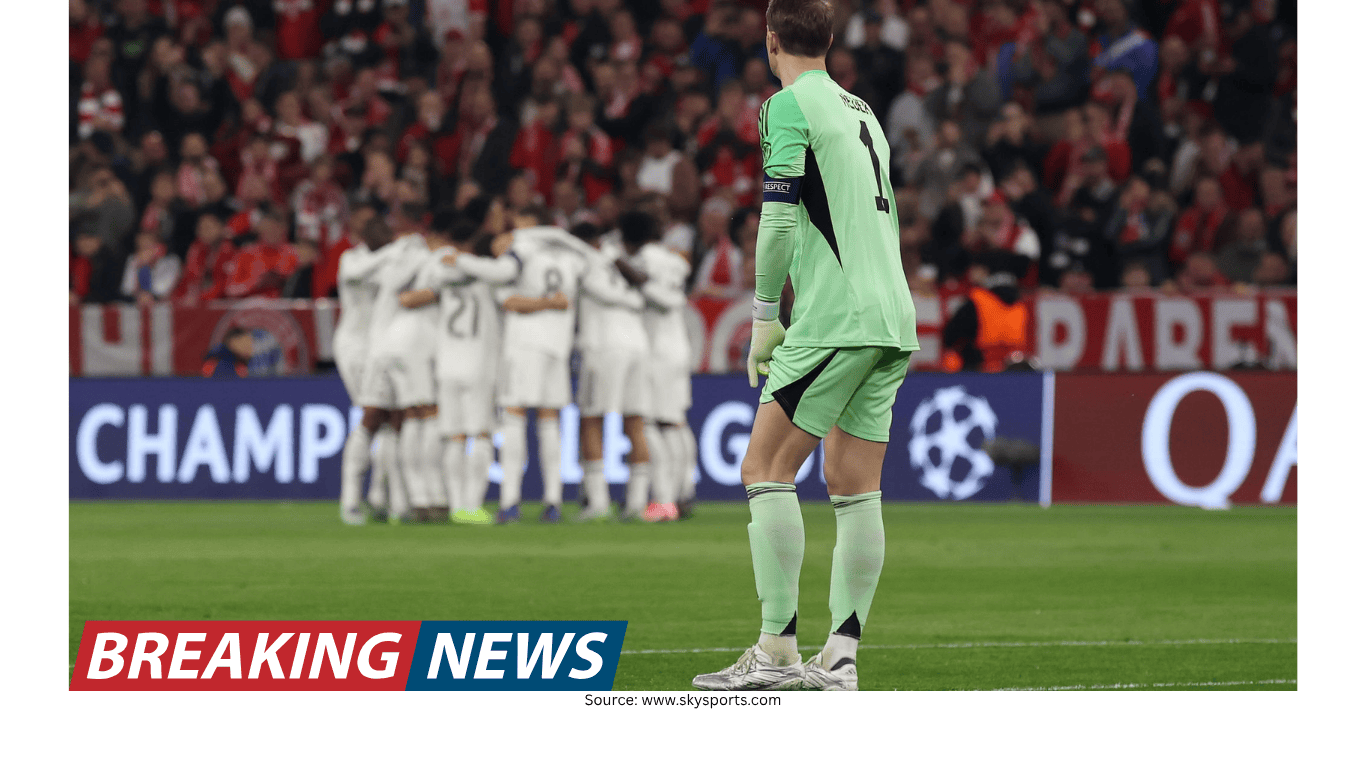
The match began in chaotic fashion almost immediately. Manuel Neuer, who had been widely praised for his performance in the first leg, was at the center of the opening moment in Munich. A sloppy pass allowed Arda Guler to ignite the action after just 35 seconds, setting the tone for a night in which goalkeepers and defenders were repeatedly forced into high-stakes decisions.
There were further pivotal moments at both ends. Real Madrid goalkeeper Andriy Lunin was unable to prevent Aleksandar Pavlovic from nodding in from near the line, a goal that added to the sense that the game could swing on any mistake. Neuer then failed to keep out Guler’s free-kick despite getting a good hand to the ball, another moment that reinforced how thin the margins were.
Harry Kane restored Bayern’s aggregate lead, continuing a remarkable season in front of goal. But Madrid had their own response. Kylian Mbappe levelled the tie once again, and by half-time the match had already delivered five goals, leaving the aggregate scoreline finely balanced and the second half set up as a test of nerve as much as quality.
Second-half tension before the decisive moment
After the break, the tie remained locked at four apiece on aggregate for much of the second half. The frantic pace of the opening period gave way to a more cautious rhythm, but the threat never disappeared. Both Michael Olise and Mbappe went close, and the sense grew that one incident—one lapse in concentration, one mistimed challenge, one refereeing decision—could decide who would advance.
That decisive incident arrived in the form of a red card for Eduardo Camavinga. The substitute was shown a second yellow card in a sequence that proved costly: he brought down Kane and then prevented the restart. The dismissal changed the dynamic instantly, leaving Madrid a man down at the point when Bayern were beginning to apply sustained pressure.
Real Madrid head coach Alvaro Arbeloa was furious with the decision afterwards, describing it as “unbelievable” and insisting it was not possible for a player to be sent off “for this” in a match of such magnitude. He said his team felt “really sad, really angry, really disappointed,” adding that the situation felt “a little bit unfair.”
Diaz and Olise deliver late Bayern breakthrough
With Madrid reduced to 10 men, Bayern found the opening they had been searching for. Luis Diaz scored in the 89th minute, a goal that arrived moments after Camavinga’s red card and finally broke Real’s resistance. It was the kind of late strike that can define a European tie—one that shifts a match from anxious possibility to near certainty.
Michael Olise then added a further goal to “add gloss,” ensuring Bayern’s advantage was reflected on the scoreboard and confirming their place in the semi-finals. Olise’s overall influence was recognized with the player of the match award, highlighting his impact in a contest filled with standout moments.
There was still time for further drama. Arda Guler was sent off for Real Madrid after the final whistle as the visitors “lost their heads” upon their exit, a final note of frustration on a night when emotions ran high from the first minute to the last.
Kane’s milestone amid the chaos
While the match will be remembered for its swings and its late turning point, it also carried a significant individual milestone. Kane’s goal meant he reached 50 goals for the season, and he became the first English player to score 50 goals for a club in Europe’s major leagues in 95 years.
Speaking after the match, Kane framed the achievement as a collective reward. He said it reflected “a lot of the hard work, not just by me but the team,” adding that it would not be possible without the players around him.
He also emphasized his focus on maintaining form and fitness over what remains of the campaign. “For me, it is just about keeping it going,” he said, pointing to the remaining weeks in a Bayern shirt and a World Cup in the summer. His priority, he explained, was to stay “physically fit and sharp” to help the team.
Kane’s comments also offered insight into the mindset of a striker in a match that repeatedly demanded resilience. He spoke about taking chances quickly, making the goalkeeper work, and contributing in multiple ways: “scoring goals, assists, defending.” The tone was one of determination rather than celebration, fitting for a player who knows the season’s biggest tests are still ahead.
Kane on the match: ‘The first half was a little bit crazy’
Kane’s post-match analysis captured the essence of the contest. He acknowledged Bayern expected a difficult evening, noting Real Madrid’s reputation in the competition and the level required to eliminate them. “Real Madrid and the Champions League have this special connection,” he said, adding that Bayern had met the standard needed to knock them out.
He described the opening period in direct terms: “The first half was a little bit crazy.” Bayern, he admitted, suffered “the worst start possible,” but he felt they recovered well and looked like the more dangerous team for stretches. At the same time, he highlighted Madrid’s threat on the transition, pointing to the way they can punish opponents quickly with the players they have.
Looking at the second half, Kane said Bayern needed to be “more patient.” His view was that as the game went on, Bayern would become “stronger and fitter and physically better,” and that belief was ultimately reflected in the late goals that decided the tie.
Key performers and match ratings
The match featured a wide range of performances, with several players producing decisive contributions in a game that demanded constant concentration. Bayern’s starting XI was listed as: Neuer, Laimer, Upamecano, Tah, Stanisic, Kimmich, Pavlovic, Olise, Gnabry, Diaz, Kane, with Davies and Musiala among the substitutes used.
Real Madrid started with: Lunin, Alexander-Arnold, Militao, Rudiger, Mendy, Valverde, Bellingham, Guler, Diaz, Vinicius Jr, Mbappe, with Camavinga introduced from the bench.
Olise was named player of the match, while Diaz’s late goal proved the breakthrough Bayern needed. Kane’s contribution was both statistical and symbolic, as his milestone arrived in the middle of a tie that demanded leadership and composure.
- Final score: Bayern Munich 4-3 Real Madrid
- Aggregate: Bayern Munich win 6-4
- Venue: Allianz Arena
- Attendance: 75,000
- Decisive moment: Eduardo Camavinga second yellow card, followed by Luis Diaz’s 89th-minute goal
- Player of the match: Michael Olise
What it means: Bayern into the semi-finals, Madrid left frustrated
Bayern’s reward is a semi-final against Paris Saint-Germain, a clash that is already being framed as a potential classic given the attacking talent involved and the stakes at this stage of the tournament. The victory also reinforces the sense that Kompany’s Bayern are building momentum, with the treble described as a possibility.
For Real Madrid, the manner of the exit will sting. They repeatedly found a way to strike first and keep the tie alive, only to be pulled back each time by Bayern’s responses. The red card to Camavinga, and the anger expressed afterwards by Arbeloa, became the focal point of their disappointment, particularly as Diaz’s winner arrived so soon after.
In the end, this was a quarter-final shaped by fine margins and big moments: early mistakes that set the tone, a flurry of first-half goals that left the tie on a knife-edge, and a late twist that tipped the balance. Bayern took their chance at the decisive time, and that was enough to send them on to the last four.