
Wolves stun Liverpool with Andre’s late winner in 2-1 Molineux upset
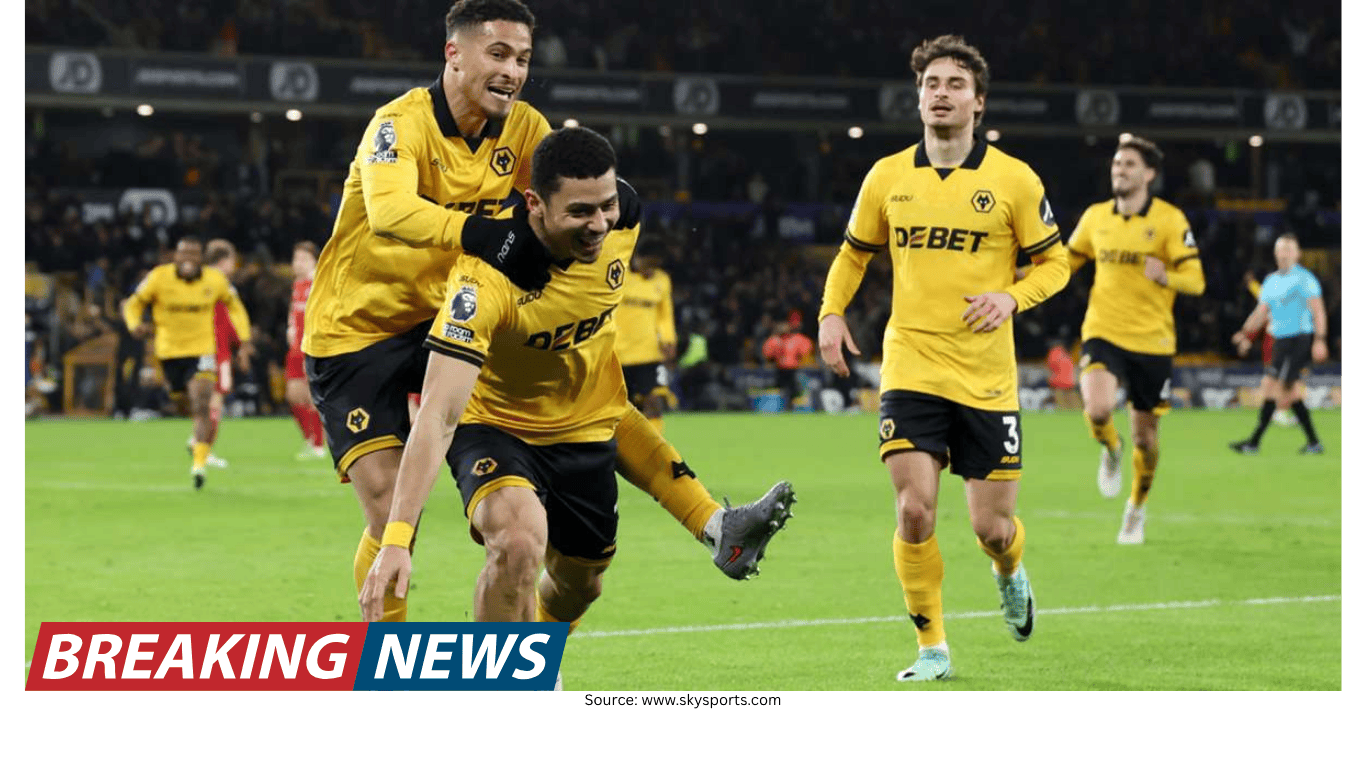
Andre’s stoppage-time strike seals Wolves win over Liverpool
Wolverhampton Wanderers produced one of their most significant results of the season, defeating Liverpool 2-1 at Molineux thanks to Andre’s dramatic stoppage-time winner. The bottom club, who had managed only one win all season until recently, followed up their victory over Aston Villa by beating the reigning Premier League champions in a match that swung sharply from a slow burn to a chaotic finale.
Rodrigo Gomes, introduced from the bench, opened the scoring well into the second half with a counter-attacking finish. Liverpool responded quickly through Mohamed Salah, whose equaliser briefly suggested the visitors might escape with at least a point. But Wolves had the final word in the 94th minute when Andre’s speculative shot deflected off Joe Gomez and found the net, leaving Liverpool to reflect on another late concession in a campaign increasingly defined by them.
A slow start, then a frantic ending
The contest began in subdued fashion, with Liverpool failing to impose themselves in the way expected of a side with ambitions of climbing the table. Wolves, buoyed by the momentum of their previous win, stayed in the game and gradually found their footing, particularly through midfield pressure and set-piece resilience. A series of corners in the first half did not translate into meaningful Liverpool threat, while Joao Gomes was described as the dominant presence during those early exchanges.
For Liverpool, the frustration was not simply a lack of goals but the sense of a first-half performance that did not match the stakes. A victory could have lifted Arne Slot’s side into third place, yet by the interval they had not built the kind of advantage their possession might normally promise. Wolves, meanwhile, were content to remain compact and competitive, waiting for moments to break.
Liverpool improve after the break but fail to capitalise
The second half brought a more assertive Liverpool, and it also brought the kind of missed opportunity that can linger long after the final whistle. Substitute Curtis Jones had a chance from close range, only to fail to convert, with Cody Gakpo’s touch on the line described as inexplicably taking the ball away from him. It was one of those moments that can change the mood of a match: Liverpool were pushing, creating, and yet still unable to find the decisive touch from open play.
That inability to make pressure count became costly. Wolves, under strain at times, retained the belief that chances would come if they stayed organised and worked. When the opening appeared, it arrived in the form of a counter-attack that exposed Liverpool’s defensive duel-making.
Rodrigo Gomes strikes after Arokodare outmuscles Van Dijk
The breakthrough came when Tolu Arokodare, another Wolves substitute, outmuscled Virgil van Dijk in a key moment. The Liverpool captain was pushed but, as the description of the incident noted, he needed to be stronger. Arokodare’s strength created the platform for Wolves to attack quickly, and he fed Rodrigo Gomes, who lifted the ball over Alisson while under pressure from Ibrahima Konate.
It was a goal that underlined Wolves’ approach: absorb, then break with speed and directness. For Rodrigo Gomes, it was a fine counter-attacking finish and a major contribution from the bench in a game where Wolves’ changes proved decisive.
Salah responds, but the equaliser does not rescue Liverpool
Liverpool’s response was swift. Mohamed Salah levelled the match, and for a period it looked as if the visitors had found a route back into control. The goal was notable in its own right: it was Salah’s first Premier League goal for 122 days, a statistic that reflected Liverpool’s broader attacking challenge in recent weeks.
Yet the equaliser did not transform the game into a Liverpool victory march. Wolves continued to fight, and Liverpool, rather than settling into a composed finish, allowed the contest to become increasingly open and unpredictable. In the final minutes, the match tilted towards the kind of late drama that has haunted Slot’s side repeatedly this season.
Andre’s deflected winner: late drama at Molineux
In the 94th minute, Andre’s shot from distance took a deflection off Joe Gomez and ended up in the net. It was a cruel moment for Gomez, but it also captured the broader theme of Liverpool’s evening: control slipping away at the worst possible time. The goal was described as speculative, and Wolves certainly benefited from the deflection, but it arrived after sustained effort and commitment from the home side.
For Wolves, Andre’s strike was enough to deliver a statement win and two victories in five days. For Liverpool, it was another damaging late concession that left them fifth in the table, rather than taking advantage of an opportunity to move higher.
A familiar late-game problem for Liverpool
The defeat added to a stark pattern in Liverpool’s season. It was noted as the fifth time in the campaign that Slot’s team have conceded a winning goal in the 90th minute or later, described as the most ever by a team in a single Premier League season. Those late slips have already derailed their title defence and, as suggested in the match report, could yet cost them Champions League football.
Beyond the headline statistic, the match also highlighted the recurring tension in Liverpool’s performances: possession and chance creation on one side, but an inability to turn open-play opportunities into goals on the other—alongside moments of defensive vulnerability that are punished disproportionately.
Team selections and key changes
Both managers made notable decisions before kick-off. Wolves boss Rob Edwards changed four players from the side that beat Aston Villa, bringing in Ladislav Krejci, Matt Doherty, Angel Gomes and David Moller Wolfe. Liverpool, by contrast, made just one change from the team that beat West Ham, with Jeremie Frimpong coming in at right-back for Joe Gomez, who started on the bench but later became involved in the decisive moment via the deflection.
Those choices shaped the match’s rhythm. Wolves’ selection and later substitutions helped them stay competitive and then become dangerous, while Liverpool’s approach was questioned by the way they “wasted the first half” and only found greater urgency after the interval.
Player ratings and standout performers
Andre was named player of the match after scoring the late winner and delivering an influential performance in midfield. Wolves also received strong marks across the back line, with several defenders rated 7, reflecting their ability to withstand Liverpool pressure for long stretches.
- Wolves (selected ratings): Sa 7, Tchatchoua 7, Doherty 7, S Bueno 7, Krejci 7, Andre 8, Joao Gomes 8, Rodrigo Gomes 8.
- Liverpool (selected ratings): Alisson 6, Frimpong 6, Konate 6, Van Dijk 6, Gravenberch 5, Mac Allister 5, Salah 6.
While ratings offer only a snapshot, they matched the feel of the game: Wolves’ intensity and cohesion against a Liverpool side that had spells of pressure but lacked sharpness in key moments and struggled to manage the closing stages.
Slot’s assessment: possession without open-play cutting edge
In his post-match press conference, Liverpool boss Arne Slot offered a blunt diagnosis. He described the result as a “same old story,” pointing to a continued struggle to score from open play despite creating chances and dominating possession. Slot noted that his team had recently picked up points by scoring from set-pieces, but that the underlying issue—difficulty converting open-play opportunities—had not changed over the last “five, six, seven games.”
Slot also criticised the first half, calling it “very poor,” including the team’s delivery and execution from set-pieces. He felt the second half was better “still not great, but better,” and referenced late moments when Liverpool came close to scoring again, including a Salah dribble where two players were open before the ball was intercepted, and a Virgil van Dijk header.
Perhaps most telling was his frustration at the nature of the winning goal conceded. Slot argued that Wolves’ second goal “was not even a chance,” and yet Liverpool ended up conceding twice from limited openings. It was, in his view, another example of what has happened “so many times” this season.
Slot added that he expected more from his team than their current position, describing the defeat as “another setback” with only nine games left. He stressed that dropping points in this manner was unnecessary and reiterated the need for Liverpool to play better rather than “rely on a deflected shot.” At the same time, he credited Wolves for fighting “from the first minute to the end” and earning the luck that came their way through effort.
Edwards: work rate and togetherness driving Wolves forward
Wolves boss Rob Edwards focused on the collective aspects of the performance. He said his team wanted to “be in the game” and believed they could improve by applying more pressure, which would cause Liverpool to “start to open up” and create “more spaces.”
Asked about the team’s improvement, Edwards framed it as a work-rate issue and suggested it can take time for players to fully grasp “how hard you have to work to win a game at this level.” He pointed to a “stark difference” in that respect and acknowledged Wolves’ limitations, describing the squad as small while emphasising that the group feels they are “not that far away.”
Edwards also said Wolves are showing they are “not as bad as people might have thought,” even if they are “not playing how I want to play.” Instead, he highlighted the “characteristics” the team are demonstrating, adding that they are “having to find a way.”
What the result means for both clubs
For Wolves, the victory represented more than three points. It showed a team at the bottom of the table can still produce a disciplined, spirited performance against elite opposition, especially when they remain patient and seize moments on the break. The win also made it two victories in five days, a notable shift for a side that had previously struggled for results.
For Liverpool, the consequences were immediate in the table. Instead of moving up to third, they remained fifth. More broadly, the match reinforced concerns about their ability to turn possession into goals from open play and their tendency to concede decisive goals late in matches—issues that have repeatedly undermined their season.
Next meeting: FA Cup tie under the Molineux lights
The two sides will not have to wait long to face each other again. Liverpool are set to return to Molineux for an FA Cup fifth-round tie on Friday evening. Edwards, anticipating the reaction from their opponents, suggested Wolves may have “made them quite angry now.”
When asked whether supporters might prefer cup success given Wolves’ league situation, Edwards pushed back on the idea that it must be one or the other, saying Wolves will “try to win both.”
Key match takeaways
- Andre’s 94th-minute, deflected shot decided the match and earned him player of the match honours.
- Rodrigo Gomes scored after coming on as a substitute, finishing a counter-attack created by Arokodare’s strength.
- Mohamed Salah equalised, but his first league goal in 122 days was not enough to secure a result.
- Liverpool stayed fifth, missing the chance to rise to third, while Wolves built on recent momentum with a second win in five days.
- The defeat added to Liverpool’s late-concession record this season, with five losses attributed to goals in the 90th minute or later.
Ultimately, Wolves’ resilience and late belief were rewarded, while Liverpool left Molineux with familiar questions about efficiency, control, and the costly moments that continue to shape their campaign.