
Tudor declines to discuss future as Tottenham’s losing run deepens after chaotic night in Madrid
Tudor’s silence on his position as pressure grows
Igor Tudor declined to say whether he deserves to continue as Tottenham head coach after another damaging defeat extended a historic losing run and intensified scrutiny around his early decisions in the role.
Asked directly after the match whether he should carry on in the job, Tudor responded: “No comment.” The refusal came after Tottenham’s 5-2 loss away to Atletico Madrid in the first leg of their Champions League last-16 tie, a result that left the club facing a daunting second leg and a difficult domestic trip that follows immediately.
Tudor has been in charge for less than a month, yet the early numbers are stark. The defeat in Madrid made him the first Tottenham head coach to lose each of his first four games in charge. It also pushed Spurs into a sixth consecutive defeat, the first time in the club’s 143-year history they have lost six matches in a row.
A disastrous first leg and a night of unwanted records
The Madrid match was described as an extraordinary night for Tottenham, not only because of the scoreline but because of the sequence of events that unfolded early on. Spurs were beaten 5-2 by Atletico Madrid, leaving the Champions League tie looking, in the words used around the game, “surely, somewhat embarrassingly, already over” with the second leg still to come.
For Tudor, the defeat added to a run of results that has quickly become the defining narrative of his short tenure. He has been in the job for 24 to 25 days, depending on the count, and the idea of a “manager bounce” has not materialised. Instead, the run of defeats has deepened, and the manner of the latest loss has raised questions about decision-making, squad confidence and the mood around the club.
The goalkeeper call that backfired
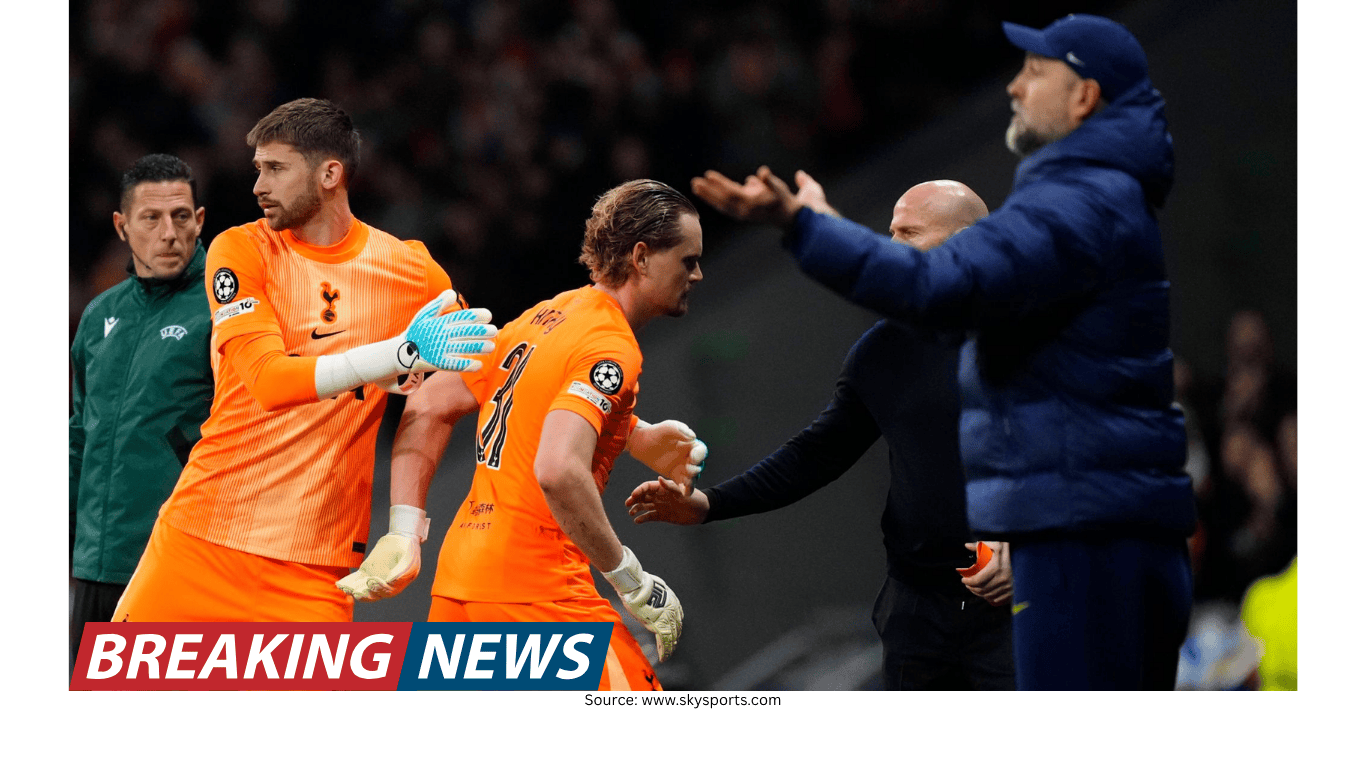
Much of the immediate criticism centred on Tudor’s handling of the goalkeeping situation. The Spurs coach made a major selection call by dropping the experienced Guglielmo Vicario and handing 22-year-old Antonin Kinsky a first Champions League start.
It proved a pivotal moment in the match. Kinsky’s mistakes contributed to two of Atletico’s three early goals, and the decision was reversed dramatically when Tudor substituted him after only 17 minutes.
The change was both rare and highly visible. Kinsky looked inconsolable as he left the pitch, and the episode became a focal point for debate about how Tottenham are coping under pressure and how fragile the team appears in difficult moments.
An early substitution and the impact on the team
Tudor acknowledged the unusual nature of removing a goalkeeper so early, describing it as something he had not done in 15 years of coaching. He framed the decision as necessary for both the player and the team.
“It is very rare. I have coached 15 years and never done this. It was necessary to preserve the guy and to preserve the team,” he said.
He also pointed to the wider context of Tottenham’s current state. “The start of the game was too much for us in this moment when we are fragile, when we are weak,” Tudor added, suggesting the early collapse was as much about the team’s collective condition as any individual error.
However, the substitution did not stabilise the match. Vicario conceded just five minutes after coming on, with Robin Le Normand scoring Atletico’s fourth goal. By that point, the scale of Tottenham’s problems on the night had become clear, and the defeat moved towards a result that would further deepen the crisis.
“It is never about one player”: Tudor’s defence of Kinsky
In his post-match comments, Tudor attempted to protect Kinsky publicly while also justifying the decision to change him. He said the player understood the moment and the reasoning, and he stressed that blame should not fall on one individual.
“Kinsky was sorry. The team is with him. Me too. I was speaking with him. He understands the moment, he understands why he went out. He is a very good goalkeeper. It is never about one player,” Tudor said.
The remarks were aimed at reframing the episode as a response to a broader fragility rather than a punitive act. Yet the optics of a goalkeeper being withdrawn after 17 minutes in a Champions League knockout match inevitably amplified the sense of turmoil around Tottenham’s current direction.
Reaction around the pitch: concern for Kinsky and questions over acknowledgement
There were also observations from Madrid that some Tottenham players appeared concerned for Kinsky’s welfare during the episode. It was noted that Joao Palhinha and Conor Gallagher ran to console the young goalkeeper as he came off.
Attention also fell on Tudor’s behaviour at the moment of substitution. It was reported that he did not acknowledge Kinsky when the player left the field, a detail that contributed to the perception of a difficult environment and added to the debate about how the situation was managed in real time.
Separately, there was mention of a powerful social media post from David de Gea about the incident, further underlining how quickly the moment travelled beyond the stadium and into wider football discussion.
Footage, denials and the sense of a “toxic” atmosphere
Additional scrutiny followed with discussion of footage appearing to show Cristian Romero almost telling Tudor to take Kinsky off. When asked about it, Tudor denied that Romero had urged him to make the change, though the existence of the footage prompted continued debate.
From the same vantage point in Madrid, the atmosphere around the club was characterised as “very, very toxic,” with the suggestion that Tudor’s future would now come under serious discussion. The argument was that the defeat was damaging in multiple ways: the scoreline, the record-setting losing run, and the handling of a young player in a high-pressure moment.
The broader assessment offered was that Tottenham have not improved since the coaching change and may, in fact, look worse, with the warning that results could deteriorate further before they improve.
What comes next: Liverpool away and a second leg that looks daunting
The immediate schedule offers little respite. Tottenham travel to Anfield to face Liverpool on Sunday, before returning to European action three days later for the second leg against Atletico Madrid.
In the wake of the Madrid defeat, Tudor was asked what needs to happen ahead of the weekend. His answer was brief and focused on his responsibilities rather than broader strategy or assurances.
“I try to do my best. What a coach needs to do,” he said.
The challenge for Tottenham is not only tactical but psychological. The team has now lost six consecutive matches, and the latest defeat came in a manner that exposed nerves, uncertainty and a lack of stability—elements that are difficult to fix quickly when the fixtures continue to come at pace.
Supporters’ Trust calls for “emergency action”
Beyond the immediate post-match analysis, the Tottenham Hotspur Supporters’ Trust issued a statement calling for “emergency action” following the 5-2 loss in Madrid. The statement described the performance and result as “a total disgrace” and framed it as a symptom of deeper issues at the club.
The Trust’s statement criticised what it described as a lack of leadership and questioned decision-making across key areas, referencing the January transfer window and management appointments. It also lamented the absence of “anyone with a Spurs pedigree” informing decisions, and it used club-associated phrases to underline the sense of disconnection supporters feel from the current direction.
“Emergency action is needed as right now we are sleepwalking off the edge of a cliff,” the statement said. It added that being a Spurs fan “has never been so difficult” and insisted supporters “will not sit by and watch the club continue to decline.”
The statement also raised the issue of match-going supporters in Madrid, saying that at the very least those attending should have their match tickets refunded. But it concluded by emphasising that what supporters want most is to feel proud of the club again, reiterating their willingness to support the team while arguing they “deserve so much more.”
A short tenure, a steep slide, and difficult questions
Tudor’s time in charge has been brief, but the situation has escalated quickly. Four defeats in his first four games have placed him in unwanted club history, while the sixth straight loss overall has set a new negative landmark in Tottenham’s 143-year existence.
The Madrid match, in particular, has become a symbol of the current crisis: a heavy defeat on a major European stage, a high-risk selection call that unravelled almost immediately, and a substitution that drew attention not only for its tactical implications but for its emotional impact on a young player.
While Tudor has insisted it was “never about one player,” the episode has sharpened the focus on leadership and decision-making at a moment when Tottenham appear, by his own description, “fragile” and “weak.”
The wider mood: results, decisions and the search for stability
Tottenham’s predicament is now defined by urgency. The club has little time to reset before facing Liverpool, and the looming second leg against Atletico Madrid arrives with the tie heavily tilted against them after conceding five in the first meeting.
At the same time, the debate around Tudor’s future is being fuelled by both results and the manner in which those results are unfolding. The absence of a positive new-manager effect, the visible strain on players, and the reaction from supporters have created a volatile backdrop.
For Tudor, the immediate task is to prepare a team that has suffered repeated setbacks and restore enough belief to compete in the next fixtures. For Tottenham, the challenge is broader: to find stability amid a run that is now historically poor, and to address the growing sense—voiced by supporters and reflected in the post-match discussion—that the club is drifting at a critical point in the season.